Dental Practice · Oral Surgery
Dental Implants
Single-tooth and multi-tooth dental implants with CBCT-guided placement.
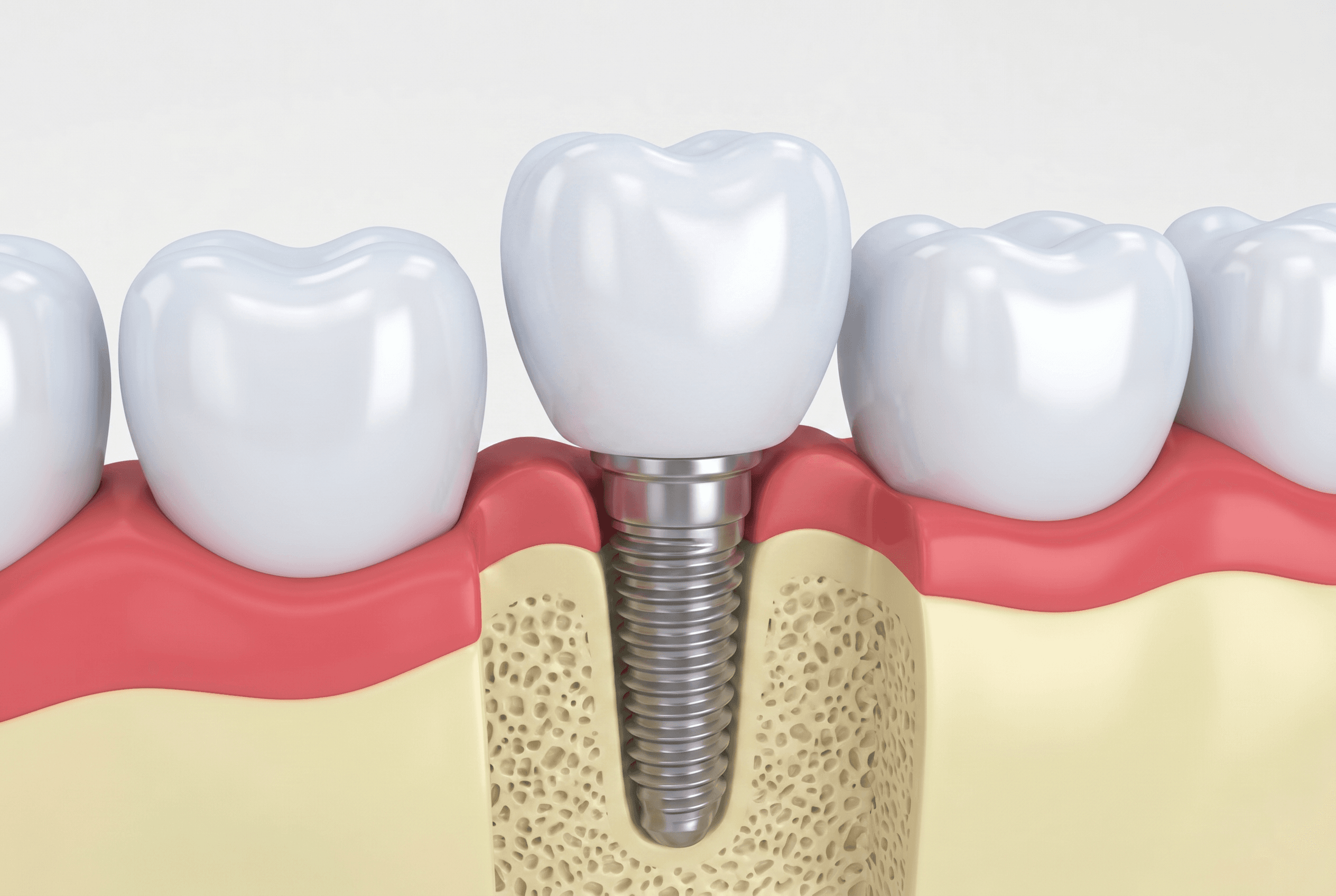
A dental implant replaces the root of a missing tooth. A titanium post integrates with the jawbone through a process called osseointegration, becoming a stable foundation that functions like a natural root — supporting a crown, bridge, or denture without involving adjacent teeth. The result is a restoration that looks, bites, and feels like a tooth. The difference between an implant and the alternatives matters clinically. A bridge requires preparing the adjacent teeth, removing healthy tooth structure to serve as anchors. A removable partial denture relies on the remaining teeth for retention and provides less chewing efficiency. An implant stands alone, preserves the adjacent teeth, and provides the bone stimulation that prevents the ridge resorption that occurs after tooth loss. Planning is the most important phase of the procedure. We use our iCAT FLX CBCT scanner to capture the three-dimensional anatomy of the site: bone volume and density, distance to the inferior alveolar nerve in the lower jaw, proximity to the sinus in the upper jaw, and the spatial relationship between the implant position and the planned crown. Placement without this level of spatial planning is placement without full information — a situation we avoid. If the extraction site did not receive a bone graft, or if bone volume has already been lost, augmentation may be required before implant placement. Most patients with a preserved site can proceed directly to surgery. The implant is placed under local anesthesia in our office. The integration period takes three to four months; during that time, a temporary restoration maintains the esthetic and spatial situation.