Dental Practice · Restorative Dentistry
Crowns & Bridges
Full-coverage restorations and multi-tooth bridges that restore function and protect the tooth.
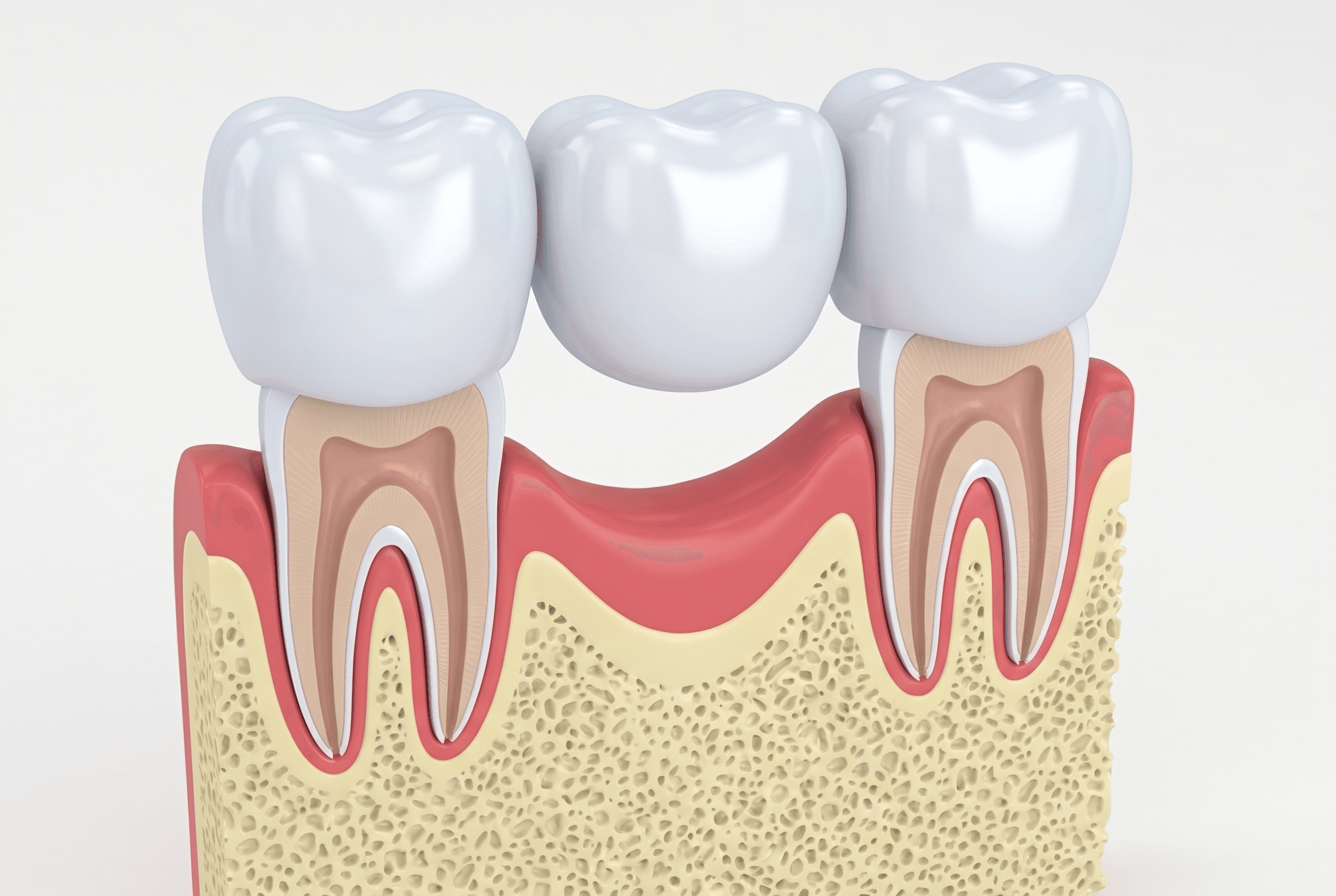
A crown is the appropriate restoration when a tooth can no longer be repaired with a filling alone: when decay is too extensive, when a fracture line runs too deep, when a large existing restoration has failed, or when a tooth has been treated with a root canal and needs full-coverage protection. The crown encases the entire visible portion of the tooth, restoring it back to functionality: the ability to bite and chew normally, to close the bite properly, and to hold its position in the arch. We design and plan crowns using our 3Shape Trios digital scanner. The scanner captures the tooth and the surrounding dentition in three dimensions without the discomfort and distortion of conventional impression trays. Digital files go directly to the laboratory, which shortens turnaround time and produces restorations with consistently accurate fit at the margin. That fit is the single most important variable in how long a crown stays in service. Material selection is matched to the clinical situation. Full zirconia is the current standard for posterior teeth under heavy load: extremely strong, biocompatible, and conservative in preparation requirements. Lithium disilicate (eMax) offers exceptional esthetics with good strength for anterior and premolar positions. Porcelain-fused-to-metal remains an option where specific clinical factors favor it. We discuss the trade-offs with you before any preparation begins. A bridge replaces one or more missing teeth by crowning the teeth on either side of the gap and suspending one or more artificial teeth between them. The adjacent teeth serve as anchors, which means some healthy tooth structure must be prepared to accommodate the crowns. For patients with natural, unrestored adjacent teeth, we discuss implants as an alternative that preserves that structure entirely. The crown and bridge appointment involves two visits: preparation and temporaries at the first; delivery and adjustment at the second. The temporary protects the prepared tooth between visits and gives you a preview of the final restoration's shape.
Also in restorative dentistry
Related services
Composite Fillings
Tooth-colored composite restorations placed to halt decay and restore tooth function.
Onlays
Custom "partial crown" restorations that rebuild damaged cusps and protect the tooth while preserving healthy structure.
Direct Composite Veneers
Esthetic-focused composite veneers placed in a single visit. Conservative and reversible.
Porcelain Veneers
Custom-shaped porcelain shells that change a smile with minimal reduction of the underlying teeth.
Dentures & Partial Dentures
Full and partial removable prosthetics, including immediate dentures.
Teeth Whitening
In-office and at-home whitening, including deep-bleaching for stubborn cases.